Screens and the Early Years: Why Sound, Story, and Play Still Matter Most
Early childhood moves at a quiet, steady rhythm. Children learn by listening, noticing, imagining, and interacting with the world around them. In these years, the simplest things do most of the work: conversation, play, repetition, music, stories. Screens, however familiar they’ve become, often run at a very different pace. They are fast, bright, and designed to hold attention rather than leave room for imagination.
Research from WHO, European public health institutions, and long-term developmental studies all point in the same direction: young children learn more from real interaction and sound-based experiences than from screens. The goal isn’t to avoid technology forever, but to understand how much space the early years need and how easily screens can take that space away.
Jonathan Haidt’s The Anxious Generation adds an important layer to this picture. It explains how early digital habits shape attention, emotion, and play, and why young children benefit from more real-world input during the years when their brains are building foundational skills.
What Screens Replace
The concern is not that screens exist. It’s that they often replace:
- back-and-forth conversation
- unstructured play
- listening and storytelling
- calm, sensory rest
These are the activities that shape language, attention, emotional balance, and imagination in early childhood.
WHO recommends no screen time under age 2, and less than one hour a day for ages 2–5, ideally less. These limits reflect something simple: young children learn best from the world right in front of them.
What Research Shows
1. Language grows through interaction, not passive viewing
A large 2023 JAMA Pediatrics study found that children with 2–4 hours of screen exposure at age 1 were more likely to show communication delays by ages 2 and 4. Four hours or more made delays significantly more likely.
Screens, mostly, don’t respond to a child’s sounds or gestures. They provide input, but not the kind of feedback loop that builds vocabulary and conversational skills.
2. Early screen habits affect attention later on
A study from the American Academy of Pediatrics found that the more TV children watched at ages 1–3, the more attention difficulties they showed at age 7. Fast-paced digital content can make it harder for young children to settle into slower experiences like listening to a story or focusing on play.
3. Screens interrupt natural learning rhythms
Background TV, overstimulating visuals, or long viewing periods all interfere with:
- concentration
- emotional regulation
- play
- sleep routines
These interruptions are small in the moment, but noticeable when repeated often.
What Helps Children Grow Instead
Sound, story, conversation, and open-ended play give young children the kind of input their brains can build on.
1. Conversation
Children learn language through responsive exchanges. Even simple narration such as “let’s put on your shoes… one shoe, two shoes” strengthens connection and vocabulary.
2. Storytelling and audio
Audio offers structure without overstimulation. Children imagine the scene themselves, which strengthens focus, creativity, and comprehension. Surveys in the UK show that more than half of children say audio stories grow their imagination more than video.
3. Music and rhythm
Soft music supports emotional balance. Lullabies calm. Repetition soothes. Sound helps children transition between parts of the day.
These inputs ask something from the child - attention, imagination, participation - rather than filling in every detail for them.
Where Koobiba Fits
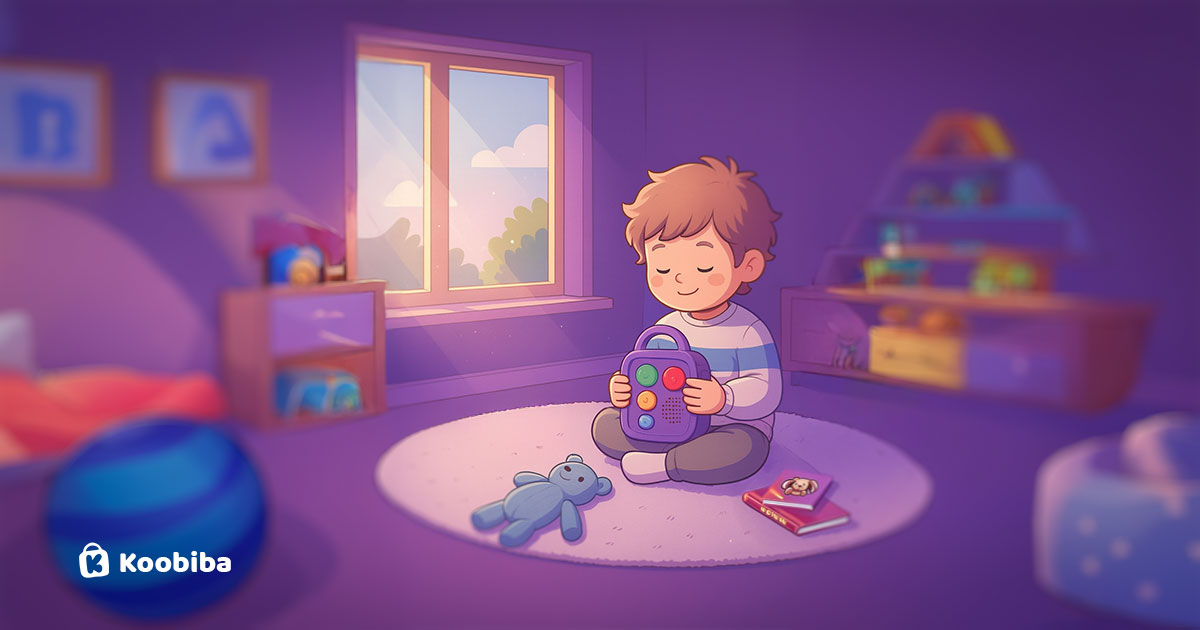
Koobiba was created to support this quieter, more spacious kind of childhood. Not as a solution to replace parents, and not as another device competing for attention, but as a gentler alternative; a way for children to listen, imagine, and focus without the pace and demands of screens.
Koobiba offers:
- stories without overstimulation
- music without distraction
- sound without visuals
- independence without digital noise
It fits alongside reading, outdoor play, and conversation, not instead of them.
A Simple Takeaway
Screens will always be part of family life. But in the early years, children benefit from more room, more quiet, and more imagination. Replacing some screen time with sound-based activities like stories, music and or favourite sounds, gives them that room.
Koobiba exists to support that shift.
References
- WHO Guidelines on Physical Activity, Sedentary Behaviour and Sleep for Children Under 5 Years (2019).
- JAMA Pediatrics (2023): Screen Time at Age 1 Year and Communication and Problem-Solving Developmental Delay at 2 and 4 Years
- American Academy of Pediatrics (2004): Early Television Exposure and Subsequent Attention Problems in Children.
- Kuhl, P. (2007). Is Speech Learning Gated by the Social Brain?
- Picton, I. (2025). Children and young people’s listening in 2024. National Literacy Trust.
- Key finding: 52.9% of children said listening to audio made them use their imagination more than watching videos.
- Hirsh-Pasek, K., Zosh, J.M., et al. (2015). Putting Education in “Educational” Apps: Lessons From the Science of Learning.
- Jonathan Haidt, The Anxious Generation (2024).